
The 3-Part Prompt That Actually Works
Most people write prompts the way they'd send a text message. One sentence. Vague. Then they're disappointed when the output is generic garbage.
Frank Ai
3/26/20262 min read
The 3-Part Prompt That Actually Works
Most people write prompts the way they'd send a text message. One sentence. Vague. Then they're disappointed when the output is generic garbage.
Here's the fix. One simple structure that works across almost every tool — Claude, ChatGPT, Gemini, doesn't matter.
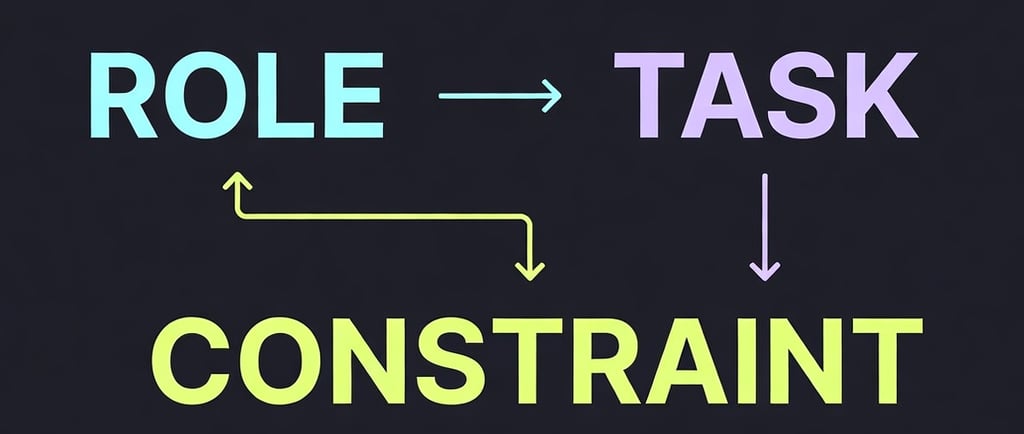
The 3-Part Prompt Framework
Role → Task → Constraint
That's it.
Role — tell the AI who it is. Task — tell it exactly what you want. Constraint — tell it what NOT to do, or how to format it.
See the difference
Bad prompt: "Write me an email about the project update."
Good prompt: "You are a project manager at a consulting firm. Write a project status update email to a client who is non-technical. Keep it under 150 words. No jargon. End with one clear next step."
Same tool. Same 10 seconds. Completely different result.
Try it this week
Pick one thing you do repeatedly at work — a type of email, a summary, a report — and write a 3-part prompt for it. Save it somewhere. Use it every time.
That saved prompt is now a workflow. That's where the real time saving starts.
This week's tool pick: Claude
If you haven't tried Claude yet, it's worth it — especially for writing tasks and analysis. The free tier is genuinely useful.
Best for: Long documents, nuanced writing, back-and-forth reasoning. Not ideal for: Real-time web browsing (unless you're on the paid plan). Tip: Use the "Start a new Project" feature to give Claude consistent context about your role so you don't have to re-explain yourself every session.
One workflow to steal
Meeting notes → action items in 60 seconds
Paste your rough meeting notes into Claude or ChatGPT
Use this prompt:
"You are an executive assistant. Read these meeting notes and extract: 1) Key decisions made, 2) Action items with owner names if mentioned, 3) Any open questions. Format as a clean bulleted list. Be concise."
That's it. Works every time.
Next edition: The AI tools actually worth paying for in 2026 — and the ones you can skip.
Browse all our workflow templates: practicalaico.ai/workflows
The Practical AI Co. — clear guides, real workflows, no hype.
Contact
hello@practicalai.co
© 2026. All rights reserved.